
Understanding Your Skin: Why Education Comes First for Barrier-Compromised Skin
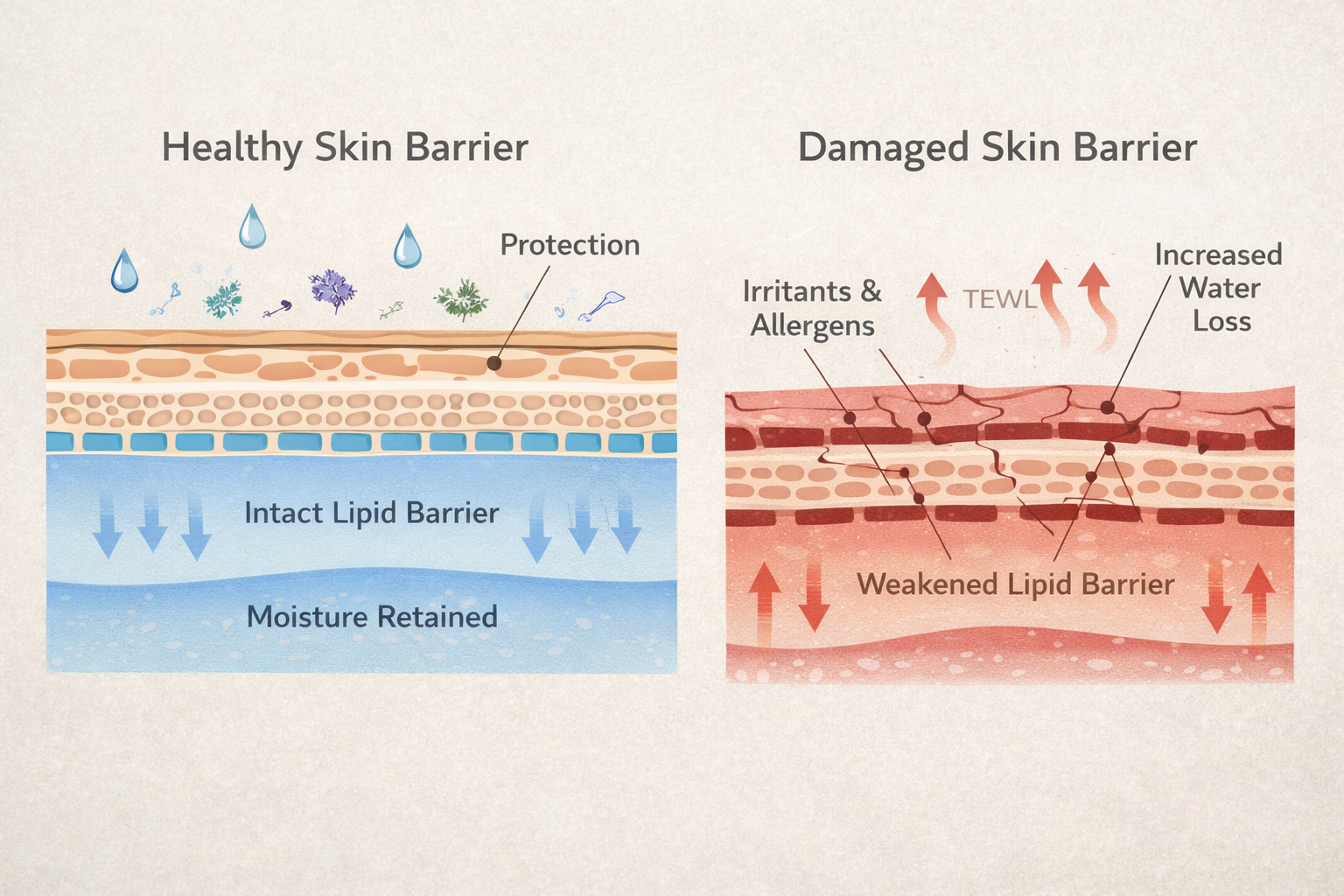
When skin is barrier-compromised, more products are rarely the answer. Understanding is. For many people living with dry, sensitive, reactive, postpartum, or flare-prone skin, skincare becomes an exhausting cycle of trial and error. New products promise relief, labels claim gentleness, and routines grow longer and more complicated, yet discomfort often persists. Education interrupts that cycle. It replaces guesswork with clarity, fear with confidence, and over-treatment with restraint. This is why education sits at the center of barrier-first skincare.
The skin barrier, the outermost layer of the skin, functions as both a shield and a gatekeeper. It helps keep water inside the skin while preventing irritants, allergens, and microbes from penetrating. When the barrier is healthy, skin feels comfortable, flexible, and resilient. When it is compromised, even products marketed as gentle can sting, burn, or worsen irritation. Barrier compromise is not rare. It can result from over-exfoliation, aggressive actives, climate stress, chronic dryness, postpartum hormonal shifts, frequent cleansing, or skin affected by eczema and flares. Yet many people are never taught to recognize when their barrier is struggling.
Without education, skincare decisions are often driven by trends, urgency, or fear. This can look like layering multiple products at once, switching routines frequently, using strong actives on already stressed skin, or chasing the idea of “repair” rather than supporting function. For barrier-compromised skin, this approach can quietly deepen the problem. Education reframes the goal. Instead of asking what will fix the skin, the question becomes what the skin needs right now to feel safe and supported.
Barrier-first education also changes how we talk about skin. Rather than labeling skin as broken or problematic, it introduces the idea of skin states—conditions that shift with environment, stress, hormones, and routine. This language matters. It removes blame, reduces pressure, and allows people to adapt their care without feeling like they are failing. A routine that works during a calm period may be too much during an active flare or not enough during postpartum changes. Education gives people permission to adjust thoughtfully instead of pushing through discomfort.
Ingredients are important, but context matters more. Education does not require memorizing ingredient lists. It means understanding function. For barrier-compromised skin, barrier-supportive lipids help maintain structure, gentle hydrators support comfort, and fragrance or unnecessary irritants add risk without benefit. At the same time, no ingredient works in isolation. Concentration, formulation, frequency, and consistency all play a role. Without education, even well-intentioned choices can lead to overuse and irritation.
Many people assume that when skin feels dry or reactive, the solution is to add more steps. In reality, barrier-compromised skin often needs fewer products, fewer variables, and more time. Education helps people step back, simplify their routines, and allow the skin barrier to stabilize. This is not about doing nothing. It is about doing the right amount and giving the skin space to recover.
When people understand why their skin reacts, what signals to pay attention to, and how their routine should evolve over time, skincare stops feeling like a battle. Education builds trust between a person and their skin. It turns skincare into a supportive practice rather than a stressful one. For barrier-compromised skin, that sense of trust and confidence is just as important as the formula itself.
Barrier-first skincare is not only about what you apply to your skin. It is about what you know. Education reduces unnecessary irritation, prevents over-treatment, and encourages long-term skin health. At UNU, education is not an add-on. It is foundational. Because when people understand their skin, they make better choices, and their skin feels the difference.
References & Sources
Berdyshev E.
Skin Lipid Barrier: Structure, Function and Metabolism. PMC, 2024.Del Rosso JQ.
Fundamentals of Skin Barrier Physiology. JCAD Online, 2025.Schild J.
The role of ceramides in skin barrier function and repair. PubMed, 2024.Schmuth M.
Skin Barrier in Atopic Dermatitis. ScienceDirect, 2024.Fujii M.
Lipid abnormalities in atopic dermatitis. Cells (MDPI), 2021.Nugroho WT.
Efficacy of ceramide-containing moisturizers. Cells (MDPI), 2023.Chovatiya R.
Role of moisturization in barrier repair. PMC, 2025.